Quiet Doesn’t Mean You Can’t: Why you don’t have to get louder to live more fully
Gutsy is a project for shy, quiet, sensitive and socially anxious people who want to express themselves more fully, connect more easily and stop feeling held back. This is the piece to read if you want to understand what Gutsy is, what I believe about shyness and confidence, and how my approach works.
We live in a world that has confused loudness with competence for so long that the confusion feels like common sense. The charismatic get hired, believed, followed, voted for. The quick and certain get the floor. The slow, the careful, the hesitant – the ones who think before they speak, who feel things deeply, who need a moment before they act – get the message, over and over, in a hundred small ways: something is wrong with you.
For some people that message arrives with extra force. The quiet Black woman who’s told she’s disengaged when she’s listening hard. The person with a stammer who withdraws after one too many interrupted silences. The student at an elite institution who can’t find their accent in the room. The neurodivergent person who’s spent years being told their way of communicating is the problem.
Absorbed young enough, repeated often enough, these messages become the inner hum you carry everywhere: what’s wrong with me? Why is everything so hard? Did everyone else get an instruction manual I missed? Why can’t I get over this?
That’s the internalised voice of a world that has consistently underestimated the quiet ones – and taught you to do the same to yourself.
Gutsy exists to unravel that. Not to turn you into a louder version of yourself. Not to teach you scripts that crumble under pressure or techniques that feel borrowed from someone else’s life. Not to force you into a macho mould or contort you to fit the dominant norm until you snap. But to help you discover that you were never the problem, to peel back the layers – and to build confidence and self-belief from deep within, in your own quiet way.
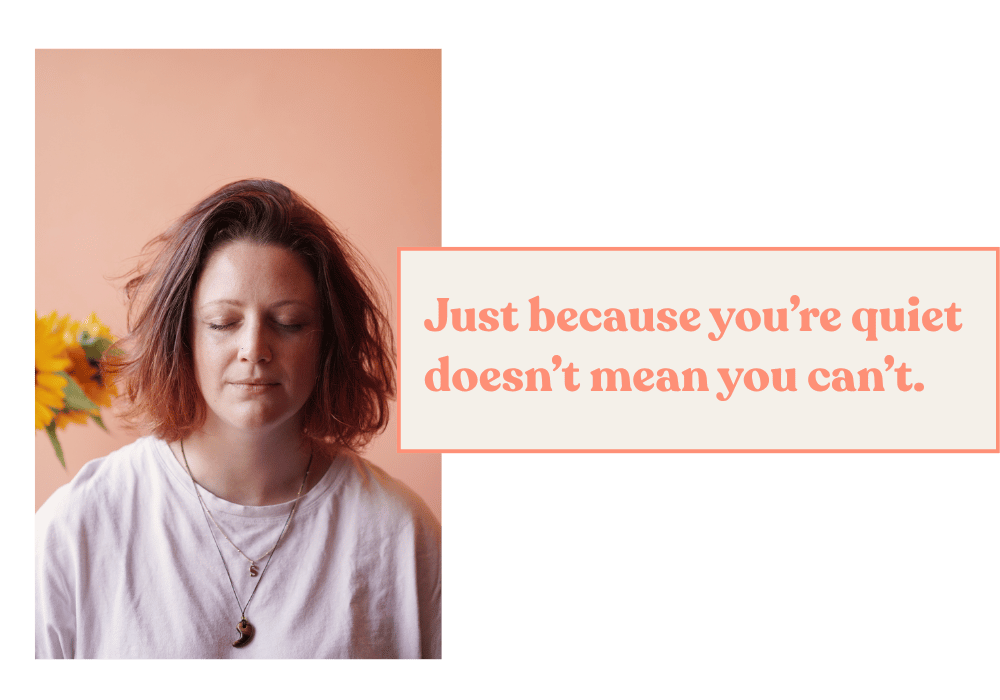
The idea at the heart of Gutsy is simple: quiet doesn’t mean you can’t. To the people who’ve been told they’re too shy, too nervous, too sensitive, not cut out for the things they want – they’re wrong about you.
Read on for more about what Gutsy is, what I believe about shyness and confidence, and why I think the dominant approaches are missing something important.
Why Gutsy?
I came up with the name ‘Gutsy’ when I was stuck in bed with Covid-19. It doesn’t surprise me at all that brilliance struck when I was extremely alone with only my thoughts for days on end – this is the introvert way!
The name is deliberate. Not ‘confident’ – a word that conjures someone loud, slick, effortlessly at ease. Not ‘brave’ – a word that sounds like white-knuckling through. Gutsy.
Guts, as in: deep inside. Not a performance, not acting like some imagined version of a confident person. Not learning scripts to fit in. Connecting to your inner world, and building the capacity to let that shine.
Guts, as in: the belly – that instinctive centre we’ve been taught to protect and hide. When you stop shaming that part of yourself and let it exist fully, something remarkable happens. You take fuller breaths. Your voice resonates. Your full expression becomes available again.
Guts, as in: the ‘second brain’ – home to over 100 million neurons, connected directly to the brain via the vagus nerve. A different kind of intelligence that helps you sidestep looping anxiety and mental blocks, and find creative flow and easy expression.
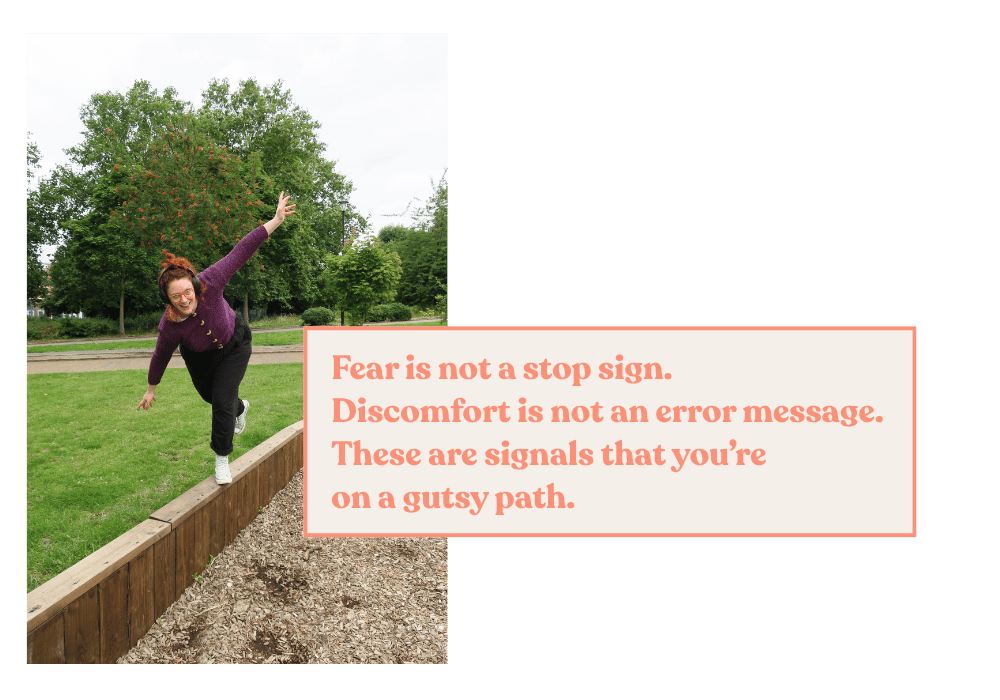
And guts, as in: the quality required to do things that are hard. Not because you’ve stopped being scared, but because you’ve learned that fear is not a stop sign.
Most confidence culture treats fear as the enemy – something to push through, overcome or eliminate. But fear, anxiety and discomfort are not errors. They’re signals: that something matters, that you’re challenging yourself, that you’re alive and doing the thing. You don’t need to wait until they’re gone. You can learn to move alongside them – to expand your capacity to hold difficulty and uncertainty. If you’re waiting until you transform yourself into some fantasy superhuman who never feels any of it, you’ll be waiting forever.
For anyone who suspects there’s a fuller life
on the other side of the fear
Get Gutsy is a free newsletter on shyness, self-expression and quiet confidence.
Join the quiet ones.
What the standard approaches get wrong
If you’ve struggled with shyness or social anxiety, you’ve probably been offered – or tried – some version of the following: change your thoughts (CBT), face your fears (exposure therapy), understand your past (psychodynamic therapy), accept yourself (person-centred or ACT approaches), manage your symptoms (medication) or learn the skills (social skills training, scripts, conversation techniques).
These aren’t useless. Most of them contain something genuinely valuable. But they can miss things.
The quick fixes – scripts, tips, social skills training – can get you through a situation. But there’s a hidden cost. The more you rely on borrowed words and rehearsed moves, the more you’re quietly confirming to yourself that your own instincts can’t be trusted, that your own ideas aren’t enough, that you need a crib sheet just to be in the room. Scripts are another mask. And when fear really kicks in – when your heart is hammering and the parts of your brain responsible for language, memory and creativity go offline – the scripts vanish anyway, and what’s left is you, plus a fresh layer of doubt. Over time, this can calcify into chronic overpreparing: rehearsing every conversation, anticipating every scenario, never quite believing you can just show up and be enough.
The insight-based approaches – therapy, understanding your past, working on self-acceptance – can be profound and important. But insight and embodied change are not the same thing. You can understand your anxiety completely, trace it back to its roots, make peace with where it came from, shine a light on the shame – and still feel it just as fiercely the moment you walk into a room full of people. Knowing why you freeze doesn’t, on its own, stop you freezing. For many people this is a source of real frustration: you’ve done the hard emotional work, spent the time and money, and yet in the moment it’s still the same story. Theory lives in the head. The anxiety lives in the body.
And then there’s the cultural gap that almost all of these approaches share: they treat shyness and social anxiety as an individual problem to be solved – alone, in a room, with a practitioner – rather than as a social experience that needs a social response. A problem that emerged in relationship and that heals in relationship.
There’s also the small matter of joy! Most of the standard approaches are serious. They’re work. They ask you to sit with difficulty, to examine yourself, to tackle discomfort head-on. All of that has its place. But change doesn’t have to feel like a second job. It can be playful, creative, surprising, even fun. And that’s not a soft option – it’s actually more effective.
What actually works — and why
Here’s what all of this points to. The thing that actually shifts anxiety is not talking about the fear, but turning towards it. Moving through it. Gaining the lived experience that you survived, that it was okay, that you can do it. Building the muscle memory and the new wiring in your brain.
Avoidance fuels anxiety.
Every time you sidestep the thing that scares you, you send your nervous system one more piece of evidence that the threat is real and that avoidance was the right call. The anxiety grows. The world shrinks. Talking about it – however carefully, however skilfully – doesn’t interrupt that cycle. Only action does.
But action without the right conditions is just more exposure to shame. Throwing yourself into scary situations and white-knuckling through is not the answer.
What’s needed is a particular kind of action: safe, held, grounded in the right conditions. A space where you can do the thing – speak, express yourself, connect, open up, be seen – and feel safe in that experience. Where your whole body and being actually gets the message, not just your intellect.
This is the idea behind what I call the ‘stress rehearsal’ – a space that feels real enough to create real experience (your nervous system doesn’t distinguish between vivid rehearsal and the real thing, which is exactly the point), but that’s carefully held, without real-world consequences, with people who genuinely understand because they’re in the same boat.
It’s real enough because you’re being gently challenged in precise ways; and it’s safe enough because the space is held with a very particular approach.
It’s grounded in self-acceptance, not shame. The premise is not that something is wrong with you and needs fixing. It’s that underneath the layers of unhelpful conditioning and adaptations you no longer need, there is already a person with something worth saying and gifts worth sharing. We’re not building a new you. We’re peeling back what’s covering the one that’s already there.
It works with the body, not just the mind. The anxiety lives in your nervous system, not your thoughts. Real change means giving your body new experiences – not just new ideas – and that requires approaches that meet you where the fear actually lives.
It’s a social solution to a social problem. Shyness and social anxiety developed in the context of other people. They heal in the context of other people – real ones, gathered together, where the felt experience of being seen and received and not judged can slowly, genuinely, rewrite the story.
And it’s playful. Drama, improvisation, creative expression – these aren’t frivolous additions to the serious work of change. They’re the mechanism. Play bypasses the self-monitoring mind. It creates conditions where you can try things on, make mistakes, be surprising, be bad, be yourself – before your inner critic has had time to object. Change that comes through play tends to stick, because you’re discovering things first-hand, just like a child does – not just listening, memorising and trying to absorb someone else’s knowledge.
This is how the change you’ve been craving can actually happen.
What shyness actually is – and what it isn’t
Shyness, introversion and social anxiety are often used interchangeably, but they’re meaningfully different things – and treating them as the same leads to confused advice.
Introversion
Introversion is a personality orientation. It’s a preference for inner over outer stimulation, for depth over breadth, for recharging alone rather than in company. It’s not shyness, it’s not anxiety and it’s not a problem. It’s how roughly a third to a half of people are wired. In a culture that prizes extraversion, it can feel like a deficit, but that’s a cultural problem – and one more and more of us are trying to shift!
Shyness
Shyness is different – it’s a form of social apprehension, a heightened sensitivity to how we’re perceived by others. Shy people can be introverted or extroverted – it’s not about needing solitude, it’s about the discomfort of social evaluation. And it exists on a spectrum, from mild awkwardness in new situations to a persistent anxiety that shapes everything from your daily experience to major life decisions.
Social Anxiety
I believe social anxiety is shyness at its most intense and pervasive: a fear of social situations that triggers physiological stress responses, leads to avoidance and can significantly narrow your world. Research suggests it’s a condition that affects up to one in eight people at some point in their lives – making it the third most common psychiatric condition worldwide, after depression and alcohol dependence. Yet it remains one of the most under-supported.
But maybe the question isn’t ‘is it shyness or social anxiety?’ but ‘what kind of social world makes both feel so hard?’ Shyness and social anxiety probably aren’t identical, but they’re closely related – maybe different points on a spectrum. More importantly, both are often treated as individual pathology when they’re also shaped by social expectations, pressure to perform and fear of judgement. It often feels like we’re pathologising ordinary vulnerability – but actually all these experiences can shift with kinder, more inclusive social conditions and the right support.
It’s also worth noting that shyness and social anxiety frequently overlap with neurodivergence – particularly autism. Some autistic people are late-diagnosed because their masking (the effortful work of appearing neurotypical) looks from the outside exactly like shyness or social awkwardness. These are related but distinct experiences, and if you recognise yourself in what’s described here but also suspect your experience goes beyond this, it may be worth exploring further.
What all these have in common is the experience of not feeling safe to be fully seen. Of monitoring yourself in real time, calculating how you’re coming across, holding parts of yourself back as protection. The exhaustion of running that dual track – living your life and critiquing it simultaneously – is profound and cumulative.
Shyness can feel painful, limiting and frustrating, but it’s not a flaw. In fact, it’s an adaptation – and often a really smart one, developed in response to real experiences. The quiet child who learned that staying quiet and still kept them safe. The teenager who discovered that watching carefully before speaking was a form of protection. These responses were wise and they worked. Behind each one is a nervous system doing exactly what it was designed to do.
For some people, the quietness wasn’t just an internal response to childhood dynamics – it was a learned, sensible adjustment to environments that were less safe for them: classrooms where their accent or appearance made them a target, workplaces where speaking up carried different risks for different bodies.
Part of the work at Gutsy is not to shame those adaptations but to understand what they do – and to gently discover which ones are still serving you and which have outlived their usefulness.
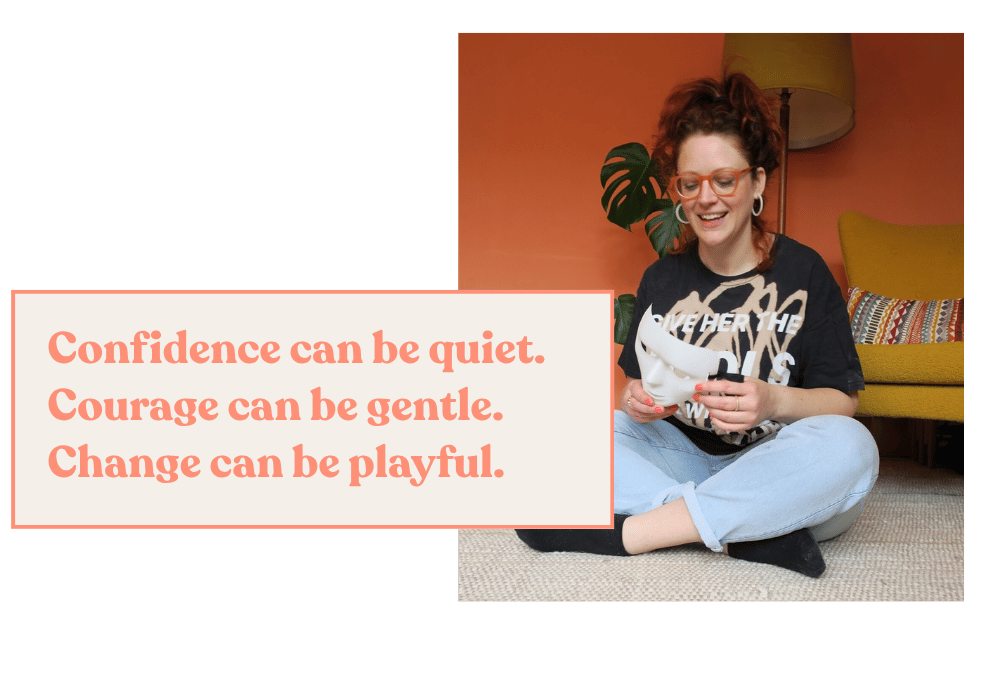
The goal of Gutsy is not to turn shy people into loud, fearless people. It’s to help people access the confidence that’s already there – beneath the self-editing, the second-guessing, the years of being told to be quieter, or louder, or more like someone else.
The Gutsy approach – four ideas that shape everything I do
Over the years of working in this space – through art, facilitation, writing, workshops and my own personal practice – I’ve arrived at a set of ideas that underpin what Gutsy does. These aren’t a methodology or a framework so much as a way of seeing.
1. Change happens in the body first
Most conventional approaches to confidence work from the top down: change your thoughts, change your beliefs, change your behaviour. But if your shyness and anxiety live in the body – in the racing heart, the dry mouth, the frozen voice, the overwhelming urge to disappear – cognitive approaches alone often don’t reach far enough.
I remember how this felt from the inside. At the height of my social anxiety, my heart would pound so hard the instant I even thought about speaking up in a meeting or a group that I’d immediately spiral into panic about the pounding itself. The physical response became its own trigger. I had no idea how to control it – and, as I later learned, trying to control it was part of the problem.
The nervous system needs to feel safe before the mind can follow. And the nervous system is not persuaded by rational argument. It’s persuaded by experience: by repeated moments of feeling okay when you expected to feel terrible, by the gradual accumulation of evidence that you can be in the room and survive it, even enjoy it.
This is why we use movement, breath, voice and physical grounding not just as warm-up exercises but as central tools. We work with the body’s own capacity for regulation – its ability to move between states, to express emotion, then to recover. The goal is not to eliminate nerves but to expand your capacity to hold them: to feel the fear and stay present anyway, rather than shutting down or fleeing.
I’ve trained in Jungian Somatics with Jane Clapp and Laura Beth Wenger, coaching the unconscious mind with Melissa Tiers, circle facilitation with Gemma Brady, and dramatherapy-informed confidence with Claire Schrader – and all these traditions share this understanding: lasting change requires working at the level of the body and the unconscious, not just the rational, logical mind.
2. Imagination is a serious tool
One of the most consistently underestimated resources we have for change is the imagination. Brain imaging research has shown that the brain activates similar neural pathways whether you’re experiencing something real or vividly imagining it – which means you can begin to create new experiences, new feelings, new possibilities in your body before they exist in your life. In sports psychology this is well established: mental rehearsal measurably improves physical performance.
This is why drama, character work, improvisation, visualisation and active imagination sit at the heart of the Gutsy toolkit. Stepping into a character who moves through the world differently – more boldly, more playfully, more freely, more outrageously – isn’t pretending. It’s a way of discovering what’s already possible for you, trying it on in a lower-stakes context, and beginning to integrate it as your own. This is the ‘stress rehearsal’: the imagination provides a safe place to practise life before you live it, so the real thing has already been visited somewhere inside you.
I encountered a story in an early workshop that has never left me. In one of the oldest myths in Japanese literature, the sun goddess Amaterasu retreats into a cave after a conflict with her storm-god brother, sealing herself inside. Because she is the sun, the world goes dark. The other gods try everything to lure her out – argument, appeals, offerings – and none of it works. What finally brings her back is something unexpected: one of the goddesses begins to dance, an uninhibited, joyful performance that makes all the gods laugh. Amaterasu hears the sound of joy in the darkness, opens the cave door a crack – and light returns to the world.
The particular gift of drama and character work and embodied imagination is that it lets you try things on before they’re real. It lets you find out what it feels like to express yourself, to be ‘bad’, to make noise, to take up space – in a context where nothing is at stake except the discovery. Like Amaterasu, many people come to this work from a place of careful hiding – and play is the way to start to shift that.
Improvisation works on the same principle. When you practise saying the first thing that comes to mind, following an impulse, accepting an idea rather than immediately editing it – you’re practising a different relationship with yourself: more trusting, less monitoring, more available to what’s actually happening.
There’s a quality of trickster energy that runs through all of this work. We hold things lightly, even when we take them very seriously. A little humour and mischief softens fear, shifts stuckness and opens space for something new. Play is serious work. And it’s one of the fastest routes I know to create change.
3. The group is the medicine
One of the cruellest ironies of social anxiety is that the thing most likely to help – human connection, shared experience, the felt sense of belonging – is the very thing that feels most threatening. If you’re shy or socially anxious, you may find yourself avoiding the groups and gatherings that could provide the most relief, precisely because those settings trigger the most fear.
Gutsy works with this directly. In group courses and workshops, we build trust slowly and deliberately, with clear structures that create genuine safety rather than just calling a space safe. Participants often arrive expecting to feel exposed and embarrassed – and discover instead something much more like relief. There’s peace in the recognition that other people feel exactly as you do. And pleasure in awkwardness that is shared rather than hidden.
The group also provides something that individual work can’t: the experience of being warmly witnessed and received. Of noticing someone nod as you speak. Of making a mistake and being met with empathy rather than judgement. And of being challenged and triggered by other people, and discovering more about yourself through that process. Your nervous system needs to experience safety in a group context, not just understand it intellectually.
The isolation of chronic shyness – the sense that you’re the only one who finds this hard, the only one who doesn’t know ‘how to just be normal’ – is one of its most painful aspects. Discovering a room full of people who feel the same way is, for many, quietly transformative in itself.
4. You don’t have to change who you are
Quiet role-models can be harder to spot – and without them, it’s easy to fall into believing that self-confidence only looks outgoing, arrogant and domineering.
But Gutsy is not in the business of turning shy people into loud, macho ones. It’s not about performing or faking ease you don’t feel. It’s not a programme for becoming more polished or more like the people who seem to find all of this effortless. It’s about quiet unfurling and courageous becoming – not hiding, masking or contorting yourself to fit the dominant norm.
I care about helping you become more at ease and more fully yourself. More able to act from your own desires rather than your fears. More available to connection, to belonging, to expression, to the parts of life that have felt out of reach. More at home in your own body, your own voice, your own way of moving through the world.
The shyness doesn’t have to disappear for this to happen. The introversion doesn’t need to be overcome. The sensitivity – which is also the perceptiveness, depth, attentiveness, the quality of attention that makes you good at so many things – doesn’t need to be dialled down. It’s the foundation you build from, not the problem you solve.
Crucially, however, this isn’t an approach that wraps you in cotton wool. Quite the opposite. Staying too cosily in the middle of my comfort zone was part of what held me back for so long – it’s easy to become scared of being scared, to panic at the first sign of panic, and start to seriously underestimate yourself.
But shy people are not fragile. Quiet people are not weak. Existing while anxious takes enormous effort – courage that goes largely unacknowledged because it isn’t loud. Gutsy is built on the belief that you can handle more than the world has given you credit for, and that the right support isn’t protection from difficulty but the conditions in which you can discover that for yourself.
Confidence in your own quiet way.
Ready to keep going?
Get Gutsy offers free essays, tools and encouragement on shyness and quiet confidence – plus news of workshops and upcoming events.
Why I do this work – and what I bring to it
I know this work from the inside. The training matters, the years of practice matter – but my lived experience is the thing that shapes everything I do.
I was a whisper-voiced child who spent years at the back of every room, watching life happen from a careful distance. Every school report criticised my quietness. I made decisions based on fear rather than desire for so long that I’d largely lost track of what I actually wanted. I was the good girl who followed the rules – and who was slowly, quietly disappearing.
When I was a teenager, I wanted to be a music critic. I was a good writer and obsessed with music. Eventually I was told I wasn’t cut out for journalism. Too quiet, too shy.
I never became a music critic. But I went one step better: I played in a feminist punk band for eight years, released an album, played and talked live on the radio, and toured the UK and Europe. Turns out nobody accuses you of being too quiet when you’re sat behind a drum kit.
I also wrote a book about feminist performance art, ran events, spoke in front of a crowd at the launch, contributed to various publications, developed the work into a gallery exhibition, and collaborated on social art projects. Throughout all of it, I hadn’t transformed into a polished, loud, poised extravert. Far from it. But I had become someone who knew, in her body, that fear is not a stop sign.
A turning point came in 2014, when I walked into a drama-for-confidence workshop run by dramatherapist Claire Schrader. Everything in me said this was a terrible idea. I went anyway. That single day cracked something open – not by making me into a different person, but by showing me that change could be playful, embodied and completely on my own terms.
I remember one exercise from those early workshops. We were playing at being ancient Greek gods – the kind of thing that seems like the absolute worst possible idea if you’re shy and self-conscious, which of course was the point. The workshop leader unexpectedly called ‘freeze’ while my arm was raised above my head. I was stuck – too good a rule-follower to defy the instruction. Standing there, arm in the air, I was completely mortified. Having my arm up, existing that visibly, that boldly, felt unbearable.
Years later, the same exercise came up when I was training to facilitate those workshops myself. Standing there, happy to strike a confident pose, I suddenly recalled that earlier moment with complete clarity – the same exercise, the same room, a profoundly different experience. Two instants across a decade, side by side. That’s when I understood, in my body rather than just my head, how far I’d come.
I’ve spent the years since doing more of that work and training across several modalities: Jungian Somatics with Jane Clapp and Laura Beth Wenger, coaching the unconscious mind with Melissa Tiers, circle facilitation with Gemma Brady, and dramatherapy-informed confidence practice with Claire Schrader. I’ve worked with practitioners in hypnosis, boundary-setting, voice, breath and movement, and woven those approaches together with a creative life that has kept expanding.
Alongside this, I’ve spent nearly twenty years as an editor – working with major arts organisations and artists and authors around the world, helping writers develop their voice and believe in the value of what they have to say. It’s work I love. And it has also been a way of being close to the thing I most wanted to do – writing – without really having to be seen doing it myself.
Julia Cameron has a phrase for this: the ‘shadow artist’ – someone who gravitates towards the creative work of others because making their own feels too exposing, too risky. Building writing back into my own life – allowing it to be seen, sharing it before it’s perfect – has been part of the same work Gutsy is built on. The newsletter, these essays, a book-in-progress, the willingness to put it all out into the world: still a practice, still a stretch.
When one of my teachers, Claire Schrader, first mentioned she was starting to offer facilitator training, I felt something rearrange inside me. Eventually, at a pub in King’s Cross after a course, I managed to steer the conversation that way – ever so casually mentioning that facilitating was sometimes something I thought I might like to try? The question mark at the end was protection from the full weight of wanting.
Claire turned to me and said: ‘I think you’d be wonderful at it.’ Even now, those words arrive accompanied by a chorus of everything I’d been told to the contrary. But she’d seen me at my limits. She knew what she was saying. Gutsy is, in no small part, a consequence of someone believing in me at the right moment.
I measure my work by the messages that arrive after a workshop or course, sometimes years later: from someone who got the job – or who didn’t get it, but came out of the room feeling like themselves for the first time in an interview. From the writer who finally shared their work. The professional who trusted themselves to speak off the cuff in the meeting. The academic who risked the open mic. The artist who stopped dreading the crit. The person who told me that a course had set them on a path they’d never have dared take otherwise.
What Gutsy actually offers
Gutsy operates across several interconnected strands – all built on the same foundation and pointing in the same direction.
Unleash
A 12-week group programme in London for shy, sensitive and socially anxious people. A structured journey through drama, expression, embodied practice and shared experience, with a small committed group over three months. Sliding scale pricing. For people who are ready to go deep.
Workshops
Occasional one-off group workshops in London. A way to experience the Gutsy approach and begin building confidence in a supported setting. A natural first step for people who aren’t ready for a full course yet, or who want to try something before committing to more.
Loose Threads
A free monthly craft gathering in London – a quiet, introvert-friendly, anxiety-conscious, low-pressure space for making things alongside others. An experiment in a different kind of gathering: one where shared silence is welcome, small talk is optional and connection happens through presence rather than performance.
Get Gutsy
A free newsletter of personal essays and reflections on shyness, self-expression and the courage to be seen. Including Props – a strand of essays each beginning with a single everyday object, exploring the interior life and the complicated business of expressing it.
One-to-one
I’m also working on developing a way to work together one-to-one online – more details on this coming soon! If this is something you’re interested in exploring, please get in touch here.
Who this is for
Gutsy is for people who have always had plenty going on inside – ideas, feelings, perspectives, creative worlds – and who find it hard to let any of it out.
It’s for the person who rehearses what they’re going to say and then doesn’t say it. Who leaves a conversation and spends the next hour replaying what they ‘should’ have said differently. Who has found ways to make themselves useful and invisible simultaneously, and who is quietly exhausted by it.
It’s for writers who struggle to share their work. Artists who find crits almost unbearable. Students who sit silent in seminars with something real to contribute. Professionals who watch the meeting end without having said the thing they came to say. It’s for the person whose accent makes them hesitate before speaking in a room where everyone else sounds the same. The first-generation student who doesn’t know the unspoken rules and so hesitates to contribute. The person who’s been told their way of communicating is wrong for so long that they’ve stopped trying.
It’s for anyone who has tried the standard advice – the power poses, the scripts, the just-push-through-it approaches – and found that it left them feeling like the problem rather than solving it.
It is not for people who want to be drilled in corporate power-posing or Extroversion 101. It’s not a room full of people competing to be the most confident. It’s not a programme for becoming someone else.
It’s for people who suspect that what they need isn’t to change who they are, but to find a way of being more fully, more freely, more courageously themselves.
And it’s for something bigger, too. We live in a lonely, fragmented time. According to the UK government’s own Community Life Survey, around 7% of adults in England – over 3 million people – report feeling lonely often or always, a figure higher than pre-pandemic levels. Meanwhile social anxiety has increased sharply among young people since Covid.
Shyness is often treated as a personal quirk to be managed. But it’s also political. The same bias that tells quiet people they’re less valuable is the bias that rewards charismatic leadership over considered leadership, that gives the microphone to the loudest voice in the room, that consistently silences people who are already navigating other forms of marginalisation. The confident and the eloquent get believed, followed, hired, heard. So many people absorb the message – directly or otherwise – that their voice is less valuable, less welcome, less worth the space it takes up.
Gutsy is, in a small way, a form of resistance to all that.
Underneath all of this – the cultural noise, the bad advice, the years of making yourself smaller – there is you. With your particular way of seeing, your particular things to say, your particular gifts and your particular inner universe.
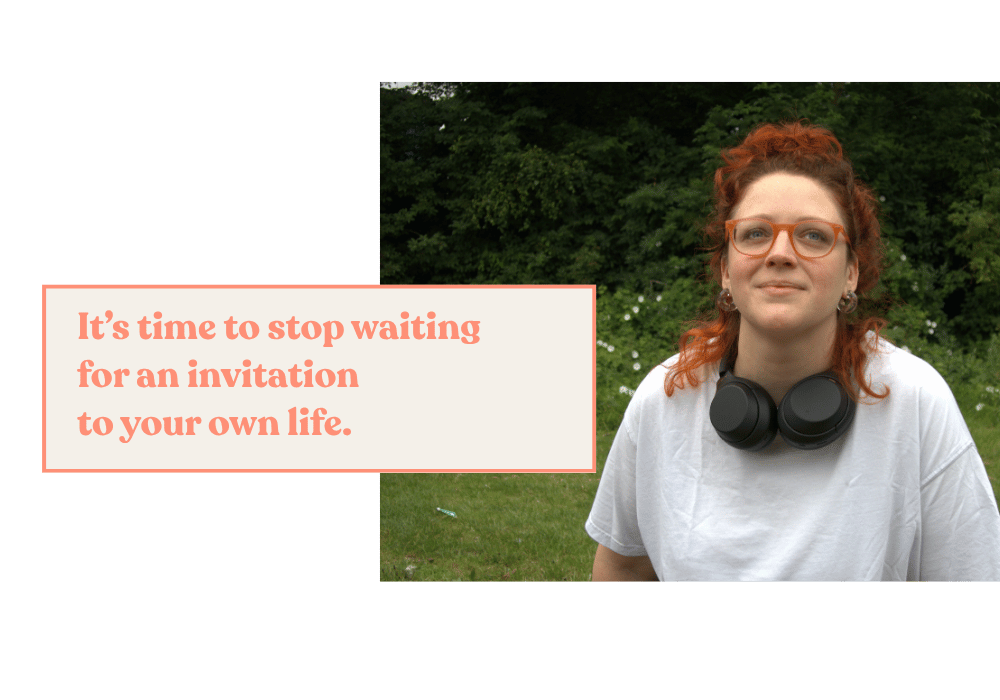
Gutsy is here to help you unlearn underestimating yourself. To build the self-trust that lets you speak, connect and belong. To drop your guard and stop hesitating on the edges of life. To help you find ease and hope and the full expression that's waiting on the other side of fear.
If this feels like you – welcome. You're in the right place.
Susannah Worth
Founder, Gutsy 🧡